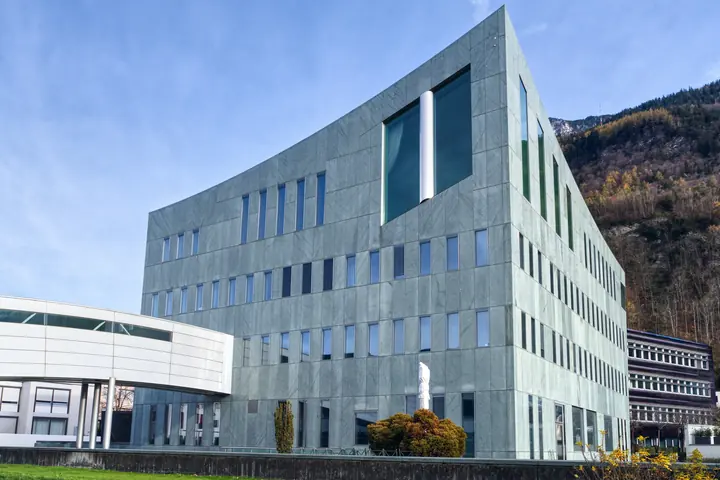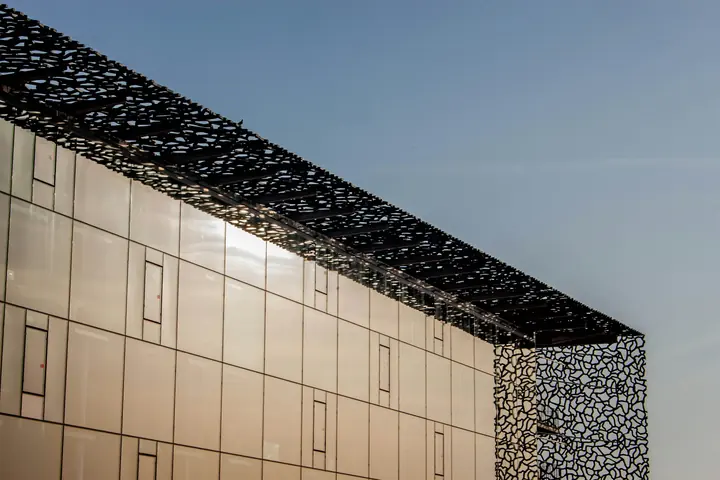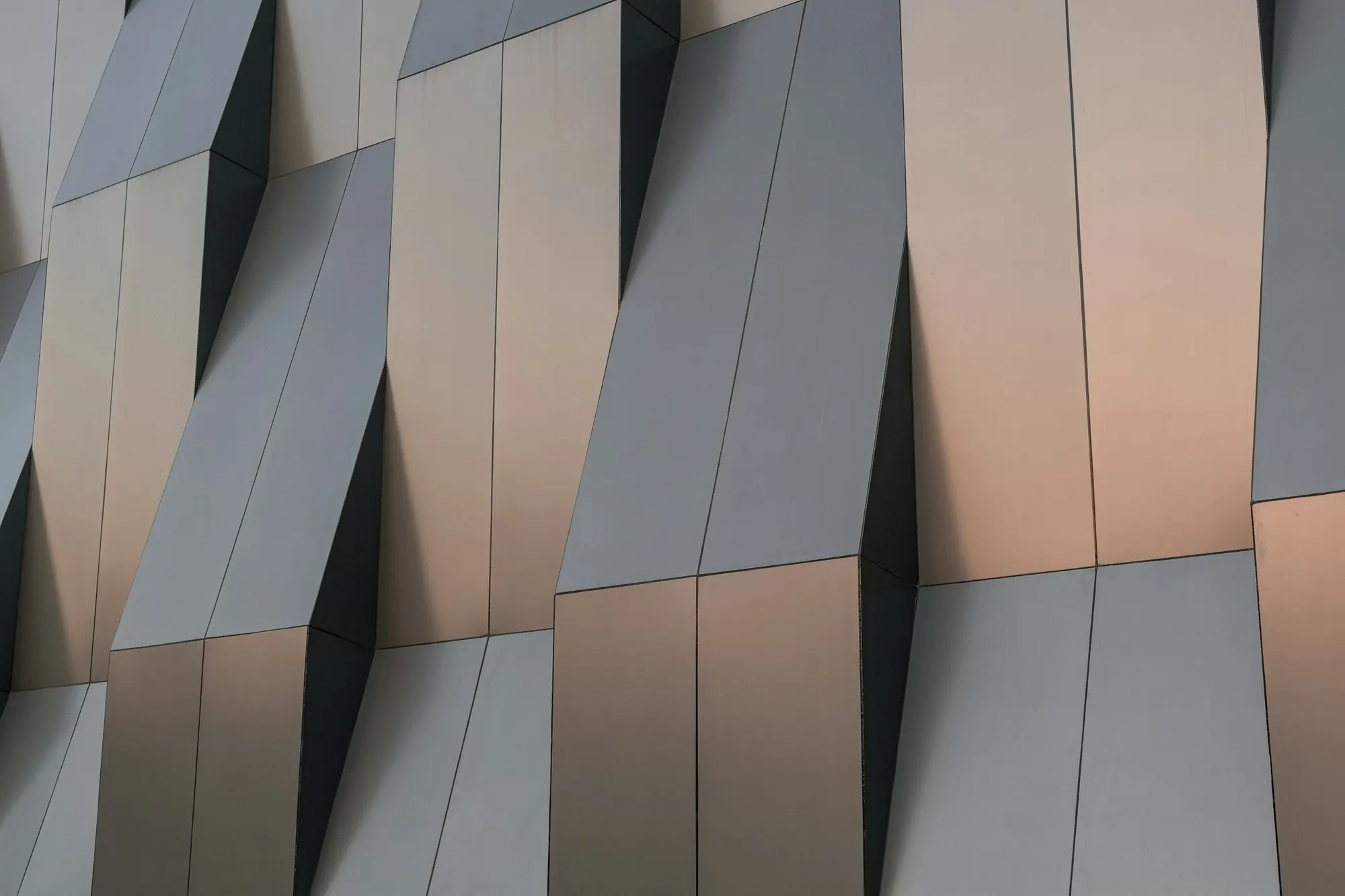
Cladding panels made of ACP and of solid aluminium can look identical from the street. Stand a metre away and they are still hard to tell apart. Behind the surface they are different products, and those differences decide cost, weight, fire performance and how the facade ages. Choosing between them is one of the most common early decisions on a cladded building, and it is worth making with the full picture.
What each one is
ACP (aluminium composite panel) is a sandwich: two thin aluminium skins bonded to a core, usually 3 to 6 mm thick in total. The core is what makes it light and flat. The panel is cut and routed on the back, folded into a tray or fixed as a flat panel, and carried on an aluminium sub-frame. Many ACP products are finished with a coil-coated paint, applied in a flat sheet before the panel is made.
Solid aluminium cladding is a single sheet of aluminium alloy, commonly 2 mm or more, cut and folded into trays, with the corners welded or riveted. The whole panel is metal. It is usually finished after fabrication, by powder coating or liquid paint, or by anodising for a metallic look. Because there is no core, it can be perforated, curved and formed more freely.
Side by side
Fire
- ACP
- Depends on the core. Standard polyethylene cores burn; fire-retardant mineral-filled cores perform much better. The core grade must match what the building requires.
- Solid aluminium
- The metal does not burn, although it softens and melts in a severe fire. There is no combustible core to consider.
Weight
- ACP
- Light and stiff for its thickness.
- Solid aluminium
- Gets its stiffness from thickness or folds, so a thicker sheet is heavier. Compare actual panel weights from the supplier, then allow for them in the sub-frame and fixings.
Flatness
- ACP
- Very flat over large panels, with a smooth, uniform look.
- Solid aluminium
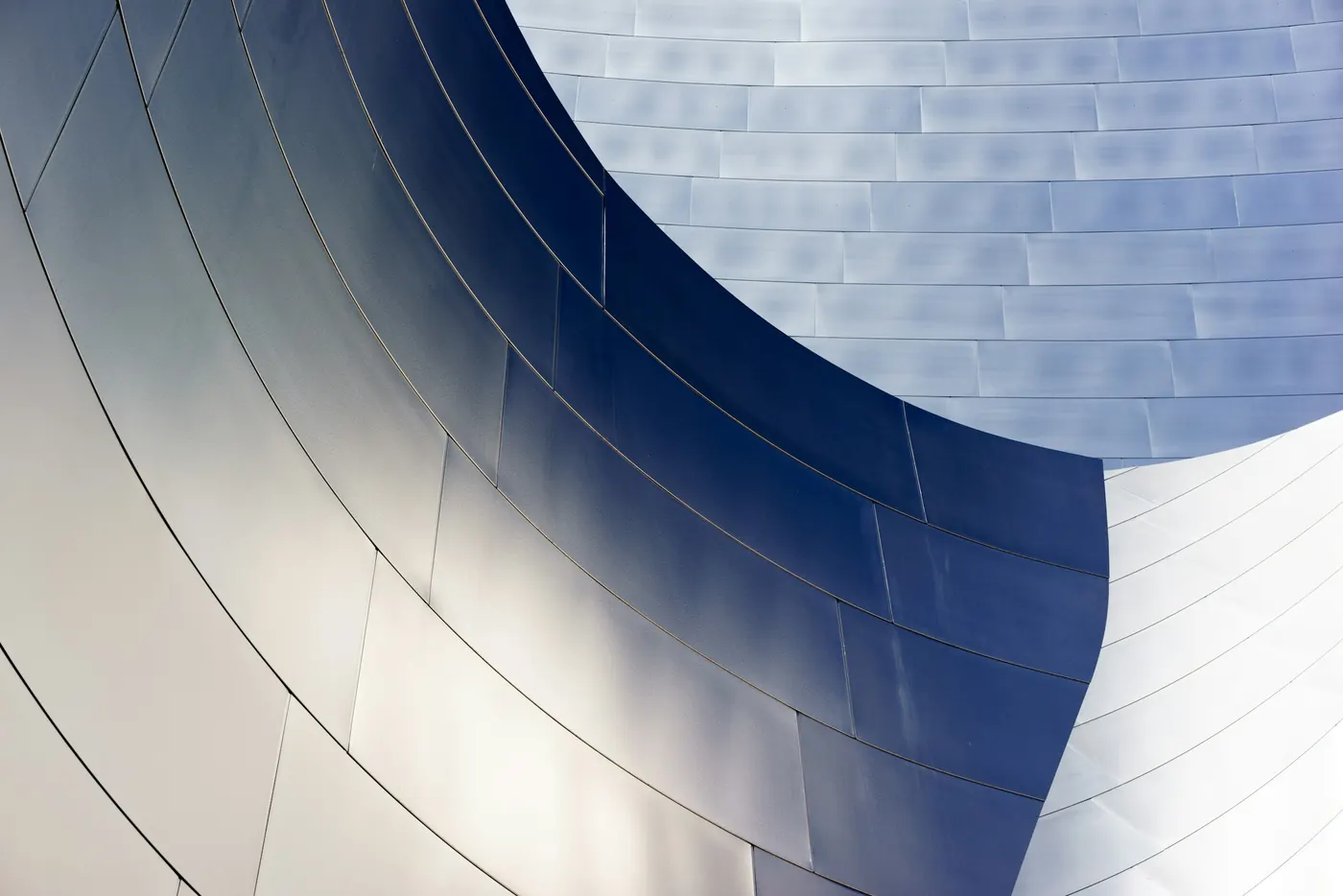
- A thin sheet can show slight waviness (oil-canning) in large flat panels unless it is thick enough or stiffened.
Shaping
- ACP
- Routed and folded: good for crisp, straight-edged trays. Tight curves and complex shapes are limited.
- Solid aluminium
- Bends, welded corners, perforation and curves are all possible, so it suits complex or custom shapes.
Damage
- ACP
- The thin skins dent more easily, and a damaged edge can expose the core.
- Solid aluminium
- A thicker sheet resists dents better, and its edges are solid metal.
End of life
- ACP
- A composite, so the skins and core have to be separated before recycling.
- Solid aluminium
- One material, straightforward to recycle.
Cost
- ACP
- Usually the lower-cost option for plain, flat panels.
- Solid aluminium
- Usually costs more, especially with complex fabrication.
Fire: the question to settle first
Of all the differences, fire is the one that can change a decision outright. A panel's behaviour in a fire depends on what is inside it. ACP with an ordinary polyethylene core can burn and drip, and many jurisdictions restrict or ban it on taller buildings or where people sleep. ACP with a fire-retardant, mineral-filled core performs far better and is the grade normally specified for buildings with fire requirements. Solid aluminium carries no combustible material, which is why it is often chosen where fire rules are strict.
Fire safety is not only about the panel. The whole cladding build-up matters: the insulation behind it, the cavity, and the fire barriers that stop a cavity acting like a chimney. Your facade consultant and the local rules decide what is allowed. Whatever is chosen, ask every supplier to state the panel's core and its test classification in writing, and keep that document in the project file.
Flatness, weight and the look of the wall
ACP is made flat and stays flat, which gives a smooth, even look across a large wall. A thin sheet of solid aluminium can show waves where light skims across a big flat panel. The cure is thickness, stiffening ribs on the back, or smaller panels, and each adds cost or weight. For the same stiffness, solid aluminium is usually heavier, so check what it means for the sub-frame, the brackets, and the anchors into the structure.
The look also depends on the joints. Panels can be fitted with open joints, closed joints, or a shadow gap between them. Wider joints, deeper returns and a crisp edge detail all depend on how the panel is made, and solid aluminium generally gives more freedom with them. Ask to see an actual sample corner, not just a flat swatch.
How to choose
- Start with fire. Check what your building's height, use and local rules require, and what your facade consultant has specified. This can settle the question before anything else does.
- Look at the shape. A plain rectilinear facade suits either panel. Curves, perforation or deep returns point to solid aluminium.
- Think about life and maintenance. Long life and hard-to-reach, high-profile elevations often favour solid aluminium; large flat areas on a controlled budget often use a fire-rated ACP.
- Check the finish. Coil-coated ACP and post-fabrication coatings on solid aluminium have different warranties and different colour ranges.
- Compare like with like. Ask every quote to state the panel thickness, core type, alloy, coating and weight.
The sub-frame matters as much as the panel
Panels get the attention, but the sub-frame carries them. It sets the alignment of the joints, takes up the tolerances of the structure, and must handle the wind load and the thermal expansion of a metal skin. A well-chosen panel on a poorly adjusted frame will show every irregularity in the wall. Most cladding is built as a rain-screen, with a ventilated gap behind the panels, and that gap is detailed the same way for either panel. See why the gap matters.
Metal expands and contracts as it heats and cools, and a long dark panel on a sunny wall can be much hotter than the building behind it. The joints and fixings must let the panels move without buckling or rattling. This is the same issue that drives movement joints elsewhere on the facade.
Panel sizes and the grid
Panels are cut from sheets or coils of a fixed width, so the sizes that waste the least material are fixed too. A grid that follows the available sheet size is cheaper and leaves fewer offcuts than one drawn freehand. It is worth asking the supplier for their economical panel sizes before the elevation is set, because a small change to a module can save a surprising amount of waste.
The joint pattern should also follow the building. Lining joints up with window edges, floor levels and corners avoids slivers of panel, which are hard to fix, easy to damage and visually awkward. Large panels reduce the number of joints but are harder to handle on site and show every irregularity of the sub-frame, so the best size is a balance between the look, the handling and the budget.
Reading a cladding quotation
Two quotations for "ACP cladding" can differ by a large margin and still describe a panel that looks the same. The difference sits in the specification. A comparable quotation states:
- the total panel thickness and the thickness of each aluminium skin;
- the core type and its fire classification, with the test report reference;
- the alloy and temper of the aluminium and, for solid panels, the sheet thickness;
- the coating system and its warranty, including limits for colour change and chalking;
- the maximum panel size and how larger areas are divided;
- the fixing method and the sub-frame it assumes;
- the weight per square metre, so that the support structure can be checked.
If an item is missing, ask for it before you compare totals. The cheapest quotation is often the one that has left something out, and the missing item reappears later as a variation.
Looking after a metal facade
Cladding is low-maintenance, not no-maintenance. Dirt and pollution collect on panels and, in dry climates, dust bakes onto the surface until the next rain. A regular wash with water and a mild detergent keeps the finish looking new and is usually a condition of the coating warranty. Inspect the joints and fixings from time to time, especially after storms, and replace any damaged panel promptly so that water cannot get behind it. Keep a few spare panels from the same batch, because colour matching a panel years later is difficult.
Mistakes to avoid
- Comparing prices without checking that the core, thickness and coating are the same.
- Specifying ACP by name only, so the supplier can quote the cheapest core.
- Ignoring panel weight when sizing the sub-frame and anchors.
- Choosing thin solid aluminium for large flat areas and then being surprised by waviness.
- Treating the sub-frame as a detail to resolve later. It is often where tolerance problems start.
Fenza's cladding range covers ACP, solid aluminium and HPL, fixed to an aluminium sub-frame and built to open or closed shadow-gap joints of 10 to 20 mm, with fire performance selected to the project requirement (indicative; confirmed per project). See Metal & Composite Cladding, or send us your elevations and we will come back with a measured scope.
General guidance for orientation, not a specification. Applicable standards, values and details are confirmed per project with the facade consultant.