Clients, funders and planning authorities increasingly ask about the carbon in a building's materials, not only the energy it uses. For a facade, that question is awkward, because the facade is both a source of embodied carbon and a means of saving operational energy. A thin, light facade may use less material but admit more heat. A heavy one may do the opposite. This article is about what embodied carbon means for an aluminium facade and what to ask for, without relying on numbers that depend on the project.
What embodied carbon includes
Embodied carbon is the greenhouse gas emitted by the materials and processes that make a building element, from raw material extraction to the point it is fitted, and in a fuller view also its maintenance, replacement and disposal. It is distinct from operational carbon, which is the energy used while the building is occupied.
For a facade, the largest contributors are usually the metal, the glass and the coating or finishing process. Sealants, gaskets, insulation, packaging, transport and site waste add to the total. A fair comparison needs to say which of these are counted and which life stages are in scope.
Where the carbon sits in an aluminium facade
Aluminium is energy-intensive to produce from raw ore, and the electricity source used in smelting strongly affects its footprint. Remelting scrap needs much less energy, which is why recycled content matters. The metal is then formed, most often by extrusion, cut, machined, finished and assembled, each step adding a smaller share.
Finishing is a place where choices matter. An anodised finish is formed from the metal itself and does not need a separate coating layer, while paint or powder coatings use additional material and a curing process. Neither is automatically better, as durability and appearance also count. The finishing choices are compared in anodised, powder-coated or PVDF.
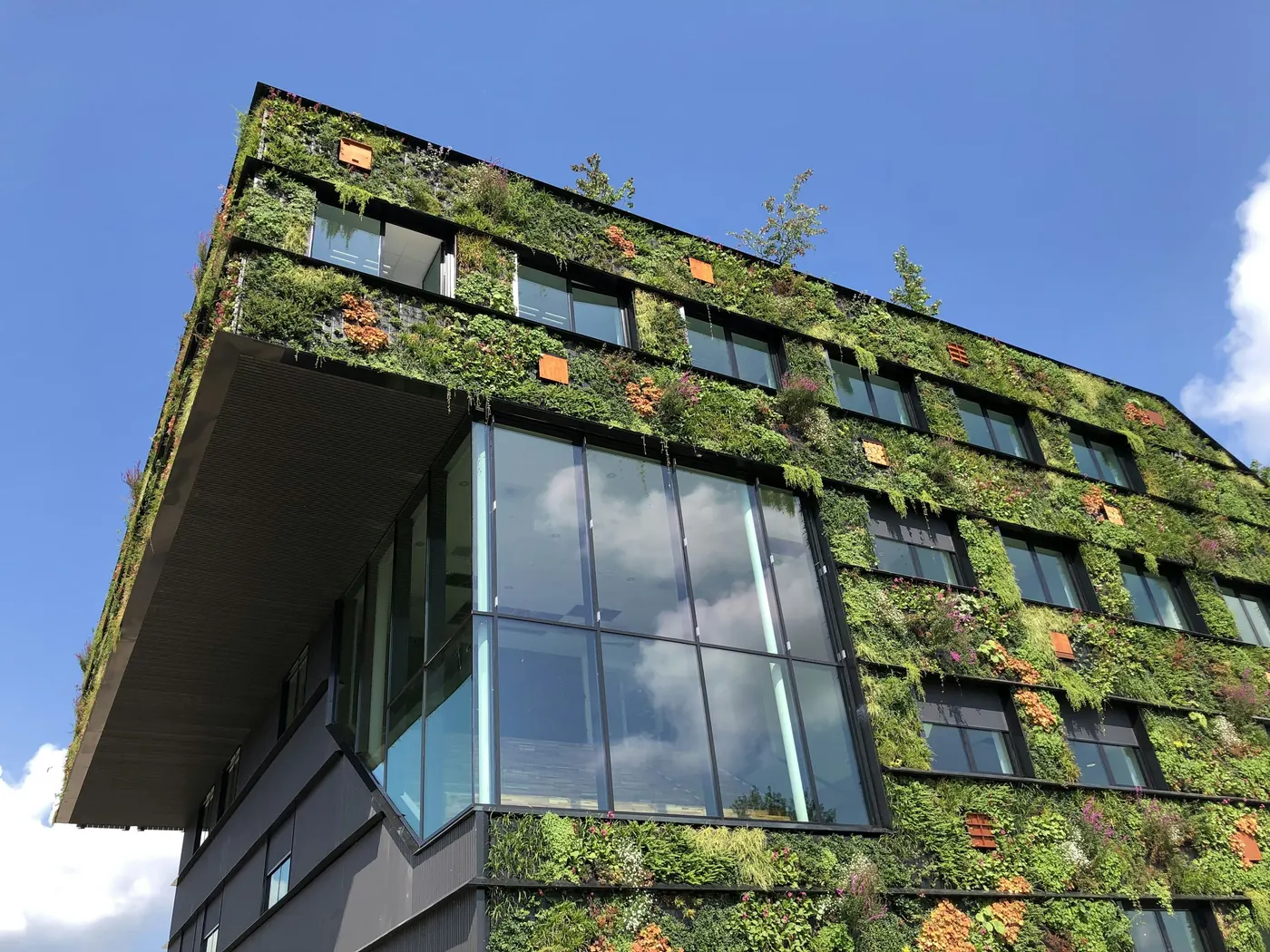
Glass often carries a share of the footprint comparable to the frame, particularly in fully glazed elevations. Double and triple units, coatings and laminated build-ups each add material and processing. So a conversation about the carbon of an aluminium facade is partly a conversation about glass, and the same questions about evidence apply to it.
Ask for recycled content, with evidence
Recycled content is the most common claim made for aluminium, and the one most in need of checking. Ask the supplier what proportion of the product supplied is recycled, how that is defined, and whether it is post-consumer scrap or factory off-cut that would have been recycled anyway. Ask whether the claim is for the specific extrusions on this project or for the producer's average.
Ask also for the source and the production route of the primary metal where that is available, since the energy source has a large effect. Documentation tied to the batch or the order is more reliable than a brochure statement. If a supplier cannot trace the metal, the claim should be treated with caution.
A related point is the difference between primary and secondary metal in the same product. Some producers blend both, and the mix can change from one order to the next. If a project wants a defined content, write it into the specification and ask for confirmation at each delivery, not once at tender. A promise that is not checked is a promise that drifts.
Environmental product declarations
An environmental product declaration, often called an EPD, is a standardised, independently verified statement of a product's environmental impact across defined life stages. It is a useful way of comparing products on the same basis. Check that the declaration is for the product you are buying, that it is in date and that the scope matches what you need.
Be careful comparing declarations from different programmes or with different boundaries. A figure for the metal alone is not comparable with one that includes finishing and transport. A declaration is not a performance guarantee for your project, and it says nothing about how the facade will be installed or maintained.
Declarations are also a snapshot. Production methods, energy supply and recycled content change over time, so a declaration that was accurate when issued may not describe today's product. Look at the validity date, ask whether the plant named is the plant that will make your material, and ask what happens if the supplier changes during the project.
Design choices that move the result
The largest savings are made in design, not in procurement. Fewer different profiles, sensible module sizes and spans that suit the standard profile reduce waste. Using no more metal than the structural and performance needs require lowers the footprint, but only if it does not compromise durability or the performance of the building envelope.
Consider how the facade's performance affects the building's operational energy. A well-performing frame with the right glazing may save more energy over time than an alternative saves in material. This is a reason to look at whole-life results, not at one stage alone, and to involve the thermal performance of the frame in the conversation.
It also helps to ask early which parts of the facade are not needed. Decorative fins, double layers and deep reveals all add metal. Some earn their place by shading the building or by giving it character, and some do not. Challenging each element in design review, before drawings are produced, is the cheapest carbon reduction available. The value engineering discussion in value engineering a facade applies here too.
Cladding choices carry the same questions. A solid panel, a composite and a perforated screen differ in material quantity, finish and weight, and the right answer depends on what the element must do. A comparison of options is in ACP versus solid aluminium cladding.
Durability, repair and end of life
A facade that lasts longer, and that can be repaired rather than replaced, spreads its initial carbon over more years. Choose finishes and details suited to the environment, so they do not need early replacement. Design for access to seals, glazing and fixings so that parts can be replaced individually, as described in the facade maintenance checklist.
At the end of life, aluminium is highly recyclable, provided it can be separated from glass, sealants and other materials. Mechanical fixings and simple assemblies are easier to take apart than bonded ones. It is reasonable to ask the supplier how the system would be dismantled and whether the metal is likely to be recovered.
Maintenance has a footprint as well. A finish that needs frequent recoating, or a seal that must be renewed often, brings repeated material, access equipment and labour. When comparing options, ask what the supplier expects to be done over the life of the facade and how often, and whether the proposed details make that work simple or awkward.
Waste, packaging and transport
Waste at the factory and on site is carbon that was produced and not used. Ask how off-cuts are handled, whether they are returned to the extruder for remelting and how packaging is managed. Standard lengths and careful cutting plans reduce off-cuts.
Transport depends on distance and mode, and on how well the load is packed. Unitised and stick systems have different transport and site implications, as described in stick versus unitised curtain wall. It is usually a smaller share than materials, but it is easy to ask about.
Finally, be wary of single-number claims. A statement such as low-carbon facade means little without a scope, a basis and a comparison. Good evidence names the product, the stages included and the assumptions made. It also admits what is uncertain. A supplier who can explain the limits of a figure is generally more reliable than one who offers a confident headline.
It is sensible to agree how carbon will be reported on the project before tender. Name the method, the life stages included and the format of the evidence. That avoids a situation in which each bidder supplies figures on a different basis and the comparison becomes a guess. The facade consultant and the project's sustainability adviser can set this out in a short schedule.
Questions to put to a supplier
- What proportion of the metal supplied is recycled, and how is that evidenced?
- Is there an environmental product declaration for this product, and what does it cover?
- What finish is proposed, and what does it add to the footprint and the service life?
- How can the system be repaired and its parts replaced individually?
- How is factory and site waste managed, and are off-cuts returned for recycling?
- What assumptions sit behind any carbon figure that is quoted?
General guidance for orientation, not a specification. Applicable standards, values and details are confirmed per project with the facade consultant.