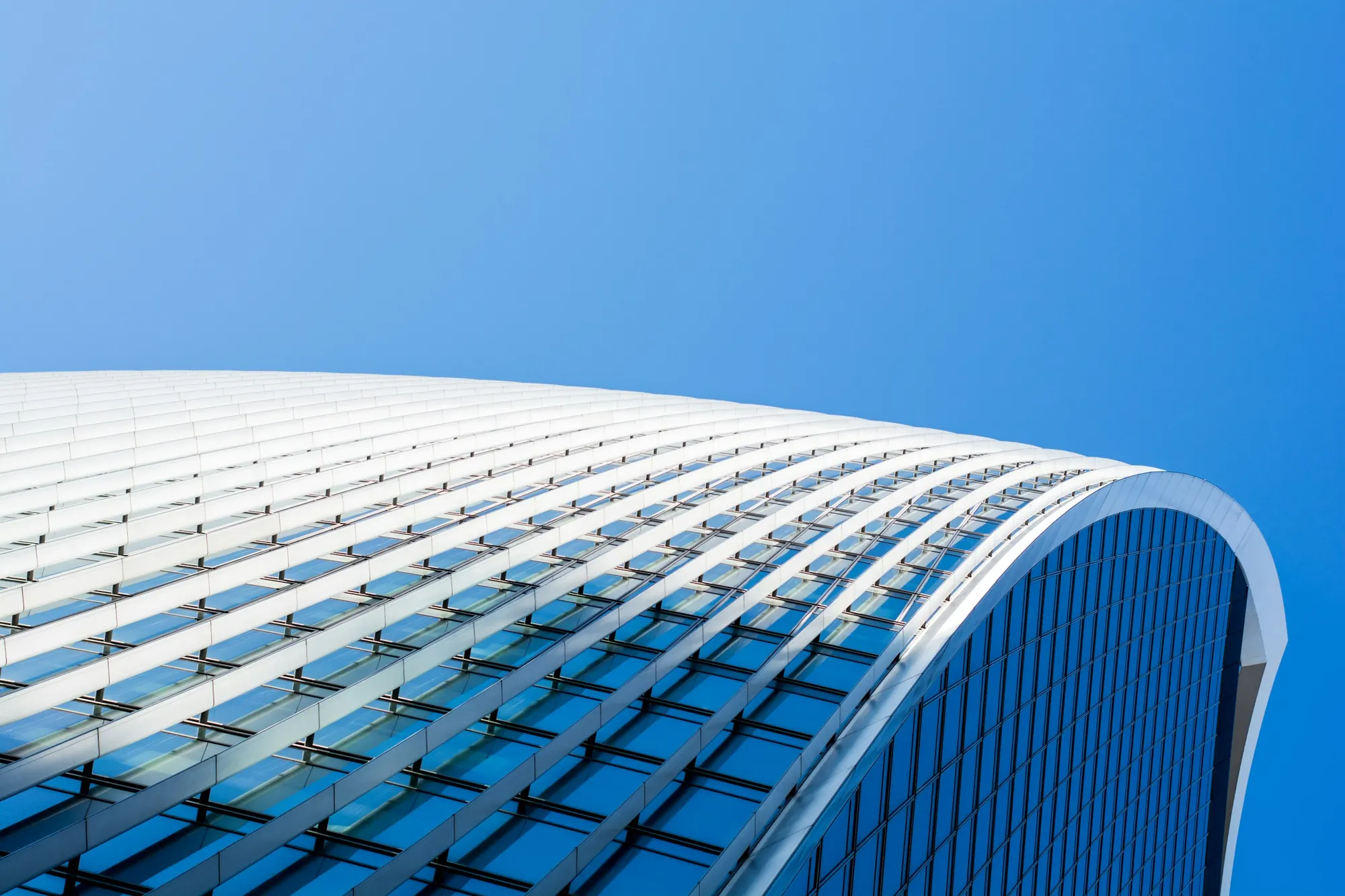
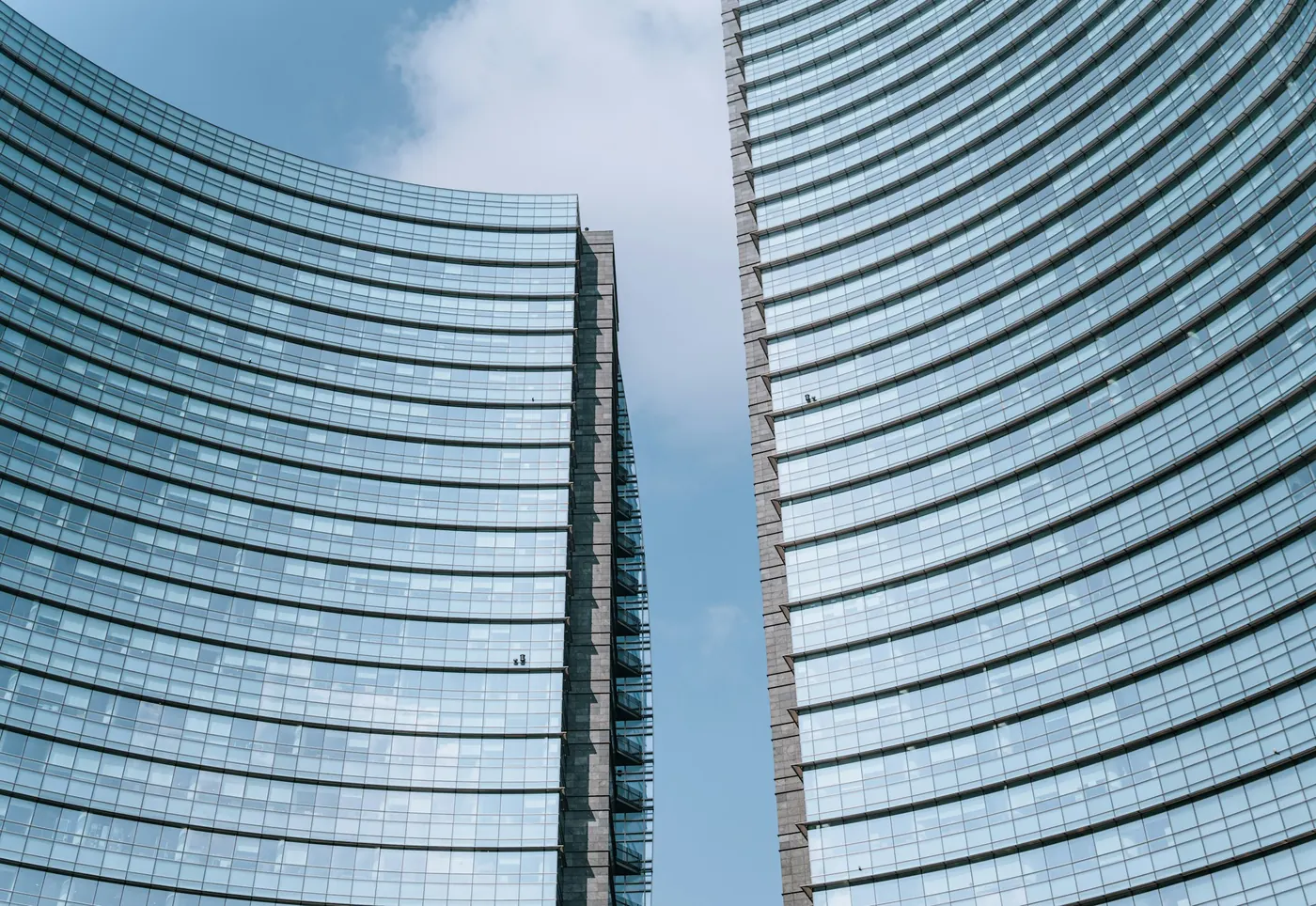
A curved facade is one of the strongest gestures an architect can make, and one of the quickest ways to add unfamiliar risk to a facade package. The glass is no longer a stock flat product. The frame is no longer a repeated stick or unit. The drawings have to carry geometry that a flat elevation does not show. This article explains the main ways to make a curve in glass, what changes in the frame and on site, and what to settle before the design is frozen.
Three ways to make a curve
There are three common routes. The first is faceting, where flat panes sit at small angles to each other and approximate a curve. The second is cold bending, where flat glass is forced into a gentle curve and held by its frame or fixings. The third is hot bending, where the glass is heated until it sags over a mould and takes a permanent shape. Each has a different look, cost and risk profile.
Faceting uses ordinary glass, so supply and replacement are straightforward. The cost is visible: the curve is read as a series of flats, and the vertical joints become the rhythm of the elevation. Cold bending gives a smooth surface without the mould cost, but only for gentle curves in one direction. Hot bending allows tighter curves and more complex shapes, with the longest lead time and the highest unit cost.
How cold-bent glass behaves
Cold-bent glass is not stress-free. The pane is held in a shape it does not want to take, so it carries a permanent bending stress that adds to wind, thermal and self-weight stress. This is why the allowable curvature depends on the glass type, the thickness and the size, and why the supplier and the facade engineer must confirm the limits instead of the architect assuming a radius.
A cold-bent pane also loads its frame. The frame resists the glass trying to spring back, so the supporting members and the fixings take a constant force as well as wind load. That changes the sizing of the mullion, the bite of the glazing pocket and the way the glass is held at its edges. Handling and replacement need their own method, because a broken cold-bent unit cannot simply be swapped with a stock pane.
What changes in the frame
A curved facade needs curved or faceted members, and often a different grid. Mullions and transoms may be rolled, bent or cut in short segments. Rolling an extrusion changes its cross-section slightly and can affect the finish, so ask how the supplier bends profiles and how the finish is protected. Corner and junction details at the ends of the curve also need their own drawings, because the standard joint assumes a flat plane.
Where the system is a curtain wall, the engineer should check how the units are anchored along the curve, how movement is taken at each floor and whether a unitised or stick arrangement suits the geometry. The stick or unitised guide is a good start. For frameless or point-fixed glazing, see structural glazing, where the silicone joint and the supporting frame must be set to a curved plane.
Glass type and treatment
Glass for bending has to be chosen with care. Fully tempered or toughened glass cannot be reshaped after treatment, so a hot-bent pane is bent first and then treated where the process allows. Laminated assemblies, with a bent layer and an interlayer, add a further step. Coatings may be limited by the bending process, so confirm early that the specified coating can be applied to the curved pane or whether it must go on a flat surface in the unit.
Optical quality is a real difference. A curved pane can distort reflections more than a flat one, and reflected images of neighbouring buildings can look wavy. Roller wave, edge distortion and mould marks are judged against an agreed standard. The glass selection guide covers the general specification points, and the glazing entry in the glossary defines the terms.
Tolerances and the reality of curves
Bent glass is not made to the tolerances of flat glass. Curvature, edge straightness and the overall shape can vary, so the frame must absorb more variation, and the joint width between panes may have to be larger than on a flat wall. Designers who draw a very tight joint on a curve may find that the manufactured glass cannot meet it.
Ask for the tolerances in writing, and for how they are measured. A template or a measuring jig is common for hot-bent panes, and a bent unit is often checked against its mould or a gauge. On site, the survey and setting-out of a curve needs more points than a straight wall. A small error at the base can grow along the arc.
Supply, sampling and replacement
Bent glass is made in a small number of specialist plants, and lead times tend to be long. A broken pane may take a long time to replace, so many projects order spares at the start. Colour match between production batches is a concern for coated glass, so a replacement may not match a ten-year-old pane exactly. Ask what the supplier will keep as tooling, and for how long.
- Sample: a full-size bent sample, seen outdoors, before the design is frozen.
- Mock-up: a representative bay with frame, glass and seals at the correct curvature.
- Spares: an agreed number of replacement panes, stored and recorded.
- Tooling: who owns the moulds, and how long they are kept.
- Handling: how bent units are packed, lifted and fitted without added stress.
Sealing, drainage and water
Water behaves differently at a curve. Sill details that rely on a flat run need to be redrawn so that water has a continuous path to the drain, and the pressure plate or glazing bead must follow the curve without gaps. Silicone joints on a curved plane can be harder to tool, so a mock-up is the best place to find out. The sealants and gaskets guide explains the general principles.
Check also how the curve meets the roof, the slab edge and the ground. A flat perimeter detail often cannot be reused, and the interface with firestopping at slab edges has to follow a changing line. Ask the supplier to draw these junctions before the grid is fixed.
Installation on site
Curved units are installed with more care than flat ones. The setting-out has to follow a surveyed arc, and each bracket position is checked against the drawing before glass arrives. Cold-bent panes are often brought into shape as they are fixed, so the sequence of tightening matters: fixings are brought up evenly, and no corner is forced to make up for an error elsewhere. The installer should have a written method for it.
Protection and handling deserve the same attention. Curved panes are awkward to carry and to lift, and a small knock on an edge can start a crack that appears later under load. Agree the lifting frames, the storage racks and the cleaning method before the first delivery, and inspect each pane on arrival against the approved sample. Record any damage at that point, not after the glass is fixed.
Finally, plan for the water check. A curved wall changes how water runs and how a hose test reaches the joints. Ask the facade consultant to choose a field test that suits the geometry, and carry it out on the first completed bay before the rest of the curve is glazed.
Questions to settle first
- What is the smallest radius, and does it need hot-bent or cold-bent glass?
- Is a faceted option acceptable, and what does it save?
- What glass types and coatings can be produced on the curve?
- How are the frame members curved, and how is the finish protected?
- What tolerances apply to the glass, the frame and the installed curve?
- What is the lead time, and what is the plan for spares?
Bring the facade consultant and the manufacturer in at concept stage, before the geometry is locked. A curve that is easy to draw can be difficult to make, and one that is carefully rationalised can look just as smooth. The best result usually comes from agreeing a small set of radii and panel widths, so the project can reuse tooling and glass sizes across the whole building.
General guidance for orientation, not a specification. Applicable standards, values and details are confirmed per project with the facade consultant.