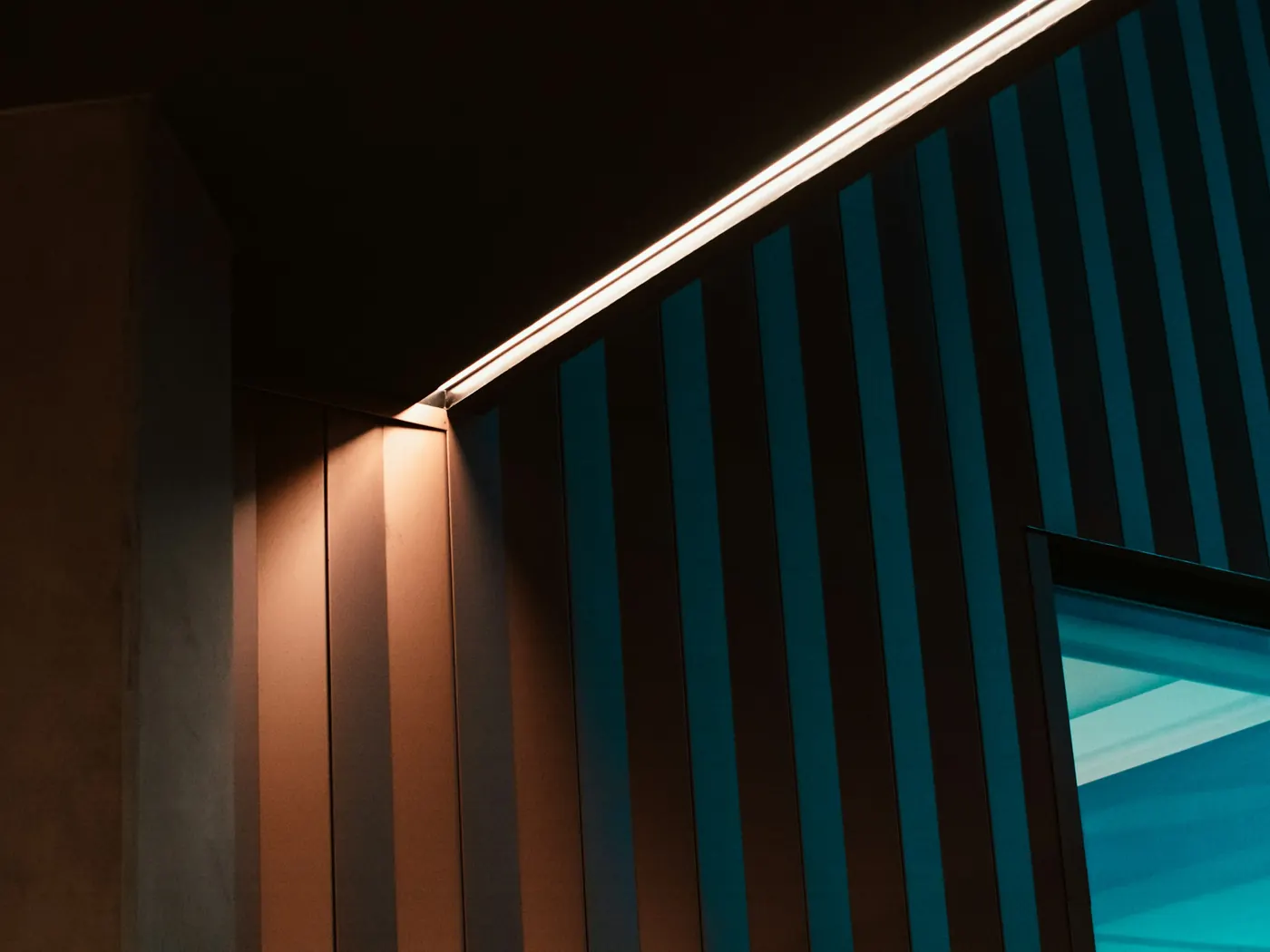
Lighting is often the last thing added to a facade design and the first thing a client notices at night. It is also one of the more common sources of small leaks. A light needs power, so a cable has to pass through the weather line. It needs to be fixed, so something has to hold it to a panel or a louver blade. It gets hot, it needs servicing and it is usually a different trade from the one that installed the facade. Each of those points is a place where water can find a way in.
None of this means lighting should be avoided. It means the fitting, the cable and the seal should be treated as part of the envelope detail, drawn at the same time as the cladding or louver that hosts them.
Start with the route, not the fitting
A lighting designer usually begins with the effect: a wash on a surface, a line of light along an edge, a glow behind a screen. The facade designer needs to begin with the route that power takes to reach each fitting. Where does the cable come from, which cavity does it run in, and where does it cross the line that keeps water out of the building?
Ask for a section through every type of fitting that shows the cable from the lamp back to the point where it enters the building. If the drawing stops at the lamp, the penetration has not been designed. The crossing point is the detail to scrutinise, because that is where an outer panel, a cavity and an inner air and water line all meet.
Keep the cable entry away from the water path
On most cladding systems water is expected to reach the cavity and drain away, as described in rain-screen cladding and the gap. A cable that enters the cavity at the top of a run of water is in a different position from one that enters at a sheltered point. Wherever possible, bring cables into the cavity from the side or from a sheltered underside, and give them a drip loop so that water running along the sheath falls off before it reaches the entry.
Avoid placing a cable gland on a flat upward-facing surface, on a sill, or directly below a horizontal joint where water collects. If a fitting has to sit in a wet zone, such as the base of a wall, ask what the supplier's detail relies on to keep it dry and whether that has been proven for the exposure and finish proposed.
Seals: what the fitting relies on
A light fitting normally depends on one of three things to stay watertight at the point where it meets the facade: a compression gasket, a bead of sealant or a formed flashing. Each has strengths. A gasket gives a controlled, repeatable result when the fitting is bolted down evenly. Sealant fills irregular gaps but depends on the installer, the surface preparation and the weather on the day. A flashing sheds water by geometry and does not wear out.
The most robust arrangement uses more than one line: a primary barrier that sheds or drains water, and a secondary seal behind it for the water that gets past. Ask which line is which. If a detail depends on a single bead of sealant for its life, ask how it will be inspected, and what happens when it needs replacing. Sealants and gaskets are covered in more depth in sealants and gaskets in facades.
Cladding and louvers as hosts
A fitting that sits on a flat panel behaves differently from one that sits in a joint, and both differ from one built into a louver blade. On a solid or composite panel, the question is whether the panel can be drilled or routed without damaging its finish or its protective edge, and whether that work is done in the workshop or on site. Cutting a hole on site tends to produce a rougher edge and a less reliable seal than one made in the factory.
On louvers, lighting is often built into the blade or the mullion behind it. The risk there is that louvers are designed to let air and some water pass, so a fitting inside the blade must tolerate occasional wetting, and the cable must not be allowed to carry water along its length into a dry area. Ask the louver supplier what the blade profile allows and whether a lit blade changes its performance.
Heat, movement and finish
A lamp produces heat, and a panel exposed to the sun produces more. Metal expands and contracts through the day, and a fitting rigidly fixed to one panel and rigidly connected to a cable fixed elsewhere will see that movement as strain. Leave slack in the cable, use a connector that can flex and make sure the fixing does not lock a panel that is meant to move. Movement is discussed in movement joints in facades.
Heat can also age the seal. Check that the gasket and sealant are rated for the temperature near the lamp, and that the fitting's own finish matches the panel behind it. A fitting that is a slightly different colour from its host will be obvious in daylight, and a different finish may weather differently.
Access and replacement
Lamps and drivers fail. If the only way to replace a unit is to open a cladding panel, every replacement risks the weatherproofing that was carefully designed. Plan for a fitting that can be reached from a maintenance route, a cradle or a lift, and that can be unplugged and removed without disturbing the surrounding seal.
Ask who will carry out replacement over the life of the building and whether they will be given the facade detail drawings. A fitting that has been replaced with a slightly different one, fixed with a different screw and sealed with whatever was on the van, is a common cause of later leaks. A short maintenance note in the handover pack helps, and the checklist in the facade maintenance checklist is a useful companion.
Who coordinates what
Lighting penetrations sit between trades. The lighting designer chooses the fitting, the electrical contractor supplies and wires it, and the facade contractor makes the opening and the seal. When the contract is silent, each may assume the other has checked the detail. The result is often a hole that was cut to suit the electrician and sealed by whoever was nearest.
Agree early who owns each penetration. One party should draw the detail, confirm that it keeps the envelope intact, and sign it off with the facade consultant. The fitting supplier should provide the cut-out dimensions and the sealing method, and the facade contractor should confirm that its system can accept them. Resolving this on paper is far cheaper than resolving it on a scaffold.
Checks at mock-up and on site
A mock-up bay is the best place to check a lighting detail, because it shows the real fitting in the real panel with the real seal. Switch the lights on and view them at night. Look for light leaking from joints, for hot spots that suggest the fitting is too close to the surface, and for visible cables. Then check the weather side: the seal should be continuous, the cable entry sheltered and the gasket evenly compressed.
On site, inspect a first completed fitting before the rest are made. Photograph each stage before it is closed up, because the cable and the seal will be hidden afterwards. A water test on a sample area, agreed with the facade consultant, is a more reliable check than a visual inspection of a bead of sealant. Test methods for the whole envelope are summarised on the testing page.
Keep a record of what was installed. A short schedule listing each fitting type, its location, its seal and its cable route is useful for the next person who needs to open a panel or replace a unit. It also helps when a leak appears years later and someone has to work out whether a light is the cause.
Questions to ask the supplier
- Which line of defence keeps water out at the cable entry, and what is the second line?
- Is the opening cut in the workshop or on site, and how is the cut edge protected?
- How does the fitting accommodate thermal movement of the panel or louver?
- Can a lamp or driver be replaced without opening the cladding or disturbing the seal?
- Who owns the penetration detail, and who has signed it off?
General guidance for orientation, not a specification. Applicable standards, values and details are confirmed per project with the facade consultant.