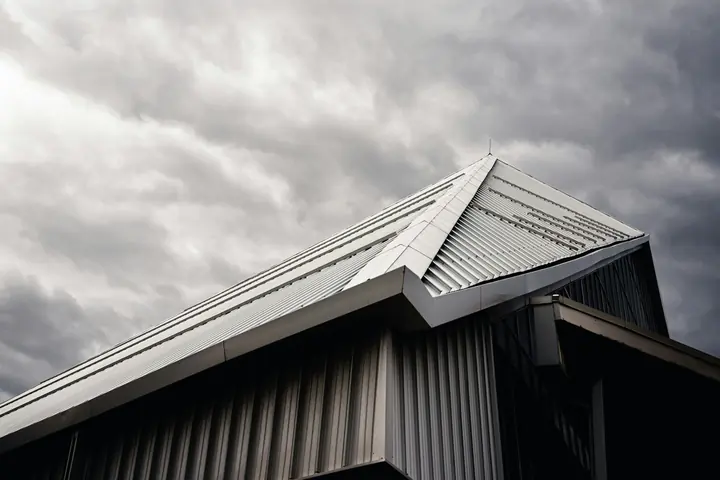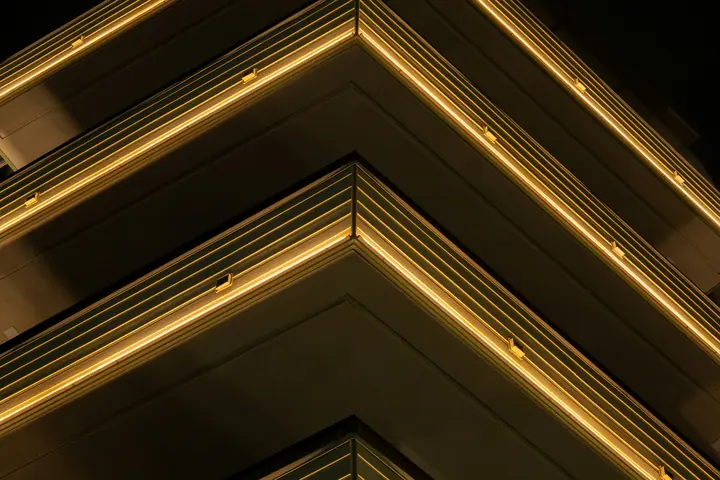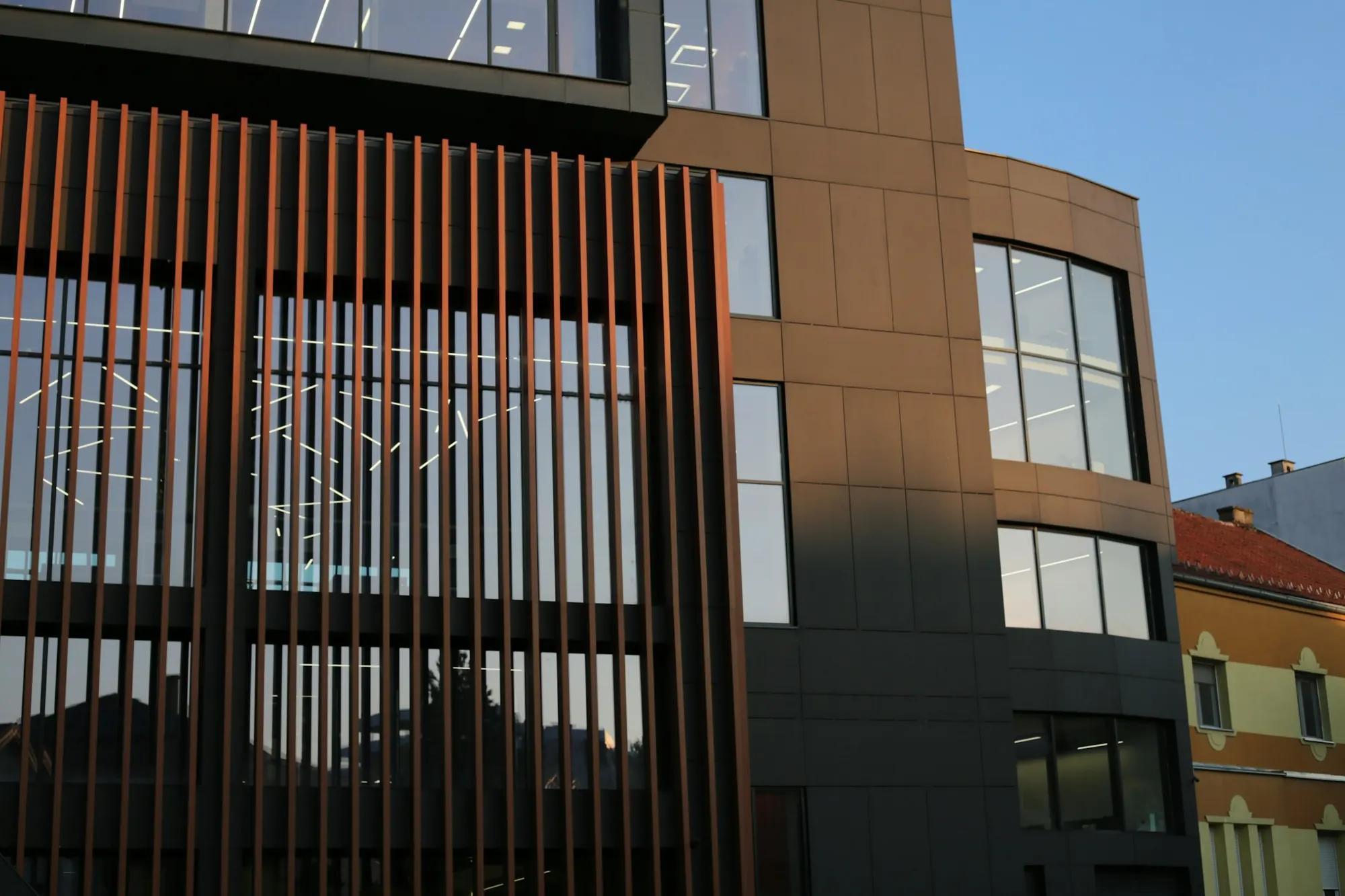
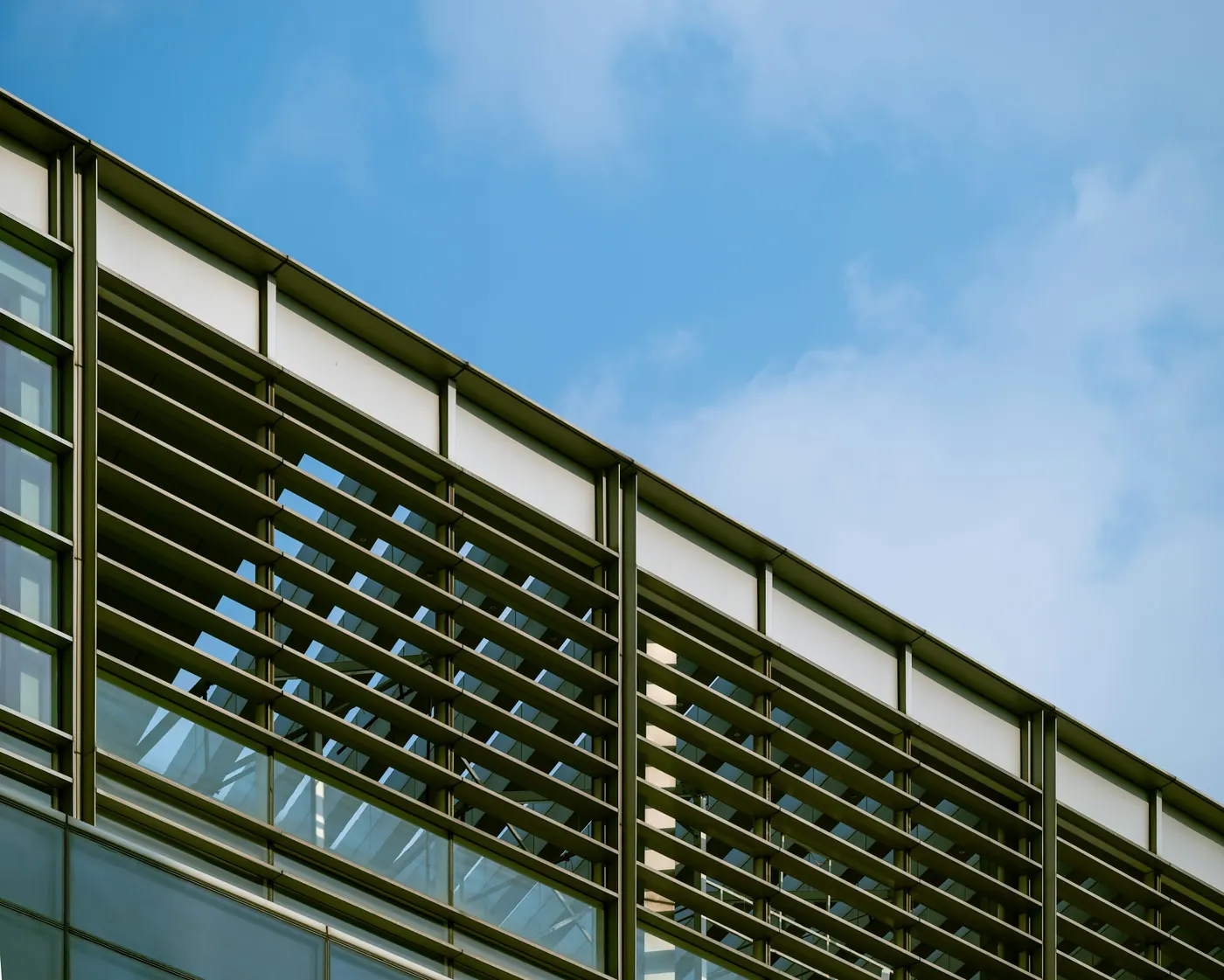
Glass lets in daylight and view, and with them the sun's heat. Blinds inside the building cut the glare but leave the heat in the room, because it has already passed the glass. A louver or fin on the outside stops the sun before it reaches the glass, which is why external shading is the more effective way to reduce solar heat gain. In a hot climate, with large areas of glass and a heavy cooling load, that difference shows up directly in the energy bill and in how comfortable the rooms are.
What they do
- Cut solar heat gain and glare, so the building needs less cooling.
- Screen plant, parking and service areas while letting air through.
- Give a facade depth, rhythm and shadow, which is often as important as the performance.
- Keep daylight and view, if the blades are designed for it, where a tinted or reflective glass would reduce both.
Orientation decides the design
The sun moves across the sky in a fixed pattern, and the shading that works on one side of a building fails on another. In India, in the northern hemisphere, the sun rides high in the south and low in the east and west, particularly in the mornings and evenings. That is the whole logic of the table below.
Horizontal fins
- Best suited to
- Elevations facing the high sun, usually the south in the northern hemisphere.
- Why
- A horizontal blade shades a window from sun high in the sky, much like an overhanging eave.
Vertical fins
- Best suited to
- Elevations that take low sun in the morning or evening, such as east and west.
- Why
- Low sun comes in sideways, so vertical blades, often angled, block it better than horizontal ones.
Fixed or operable
- Best suited to
- Fixed where the sun angle is predictable, operable where flexibility matters.
- Why
- Operable blades adapt through the day and season, but add motors, controls and maintenance.
Blade shapes
Louver blades are extruded aluminium sections, and the shape changes both the look and the behaviour. An aerofoil blade is a smooth, wing-like section that sheds air with little resistance, which suits large fins and reduces noise in wind. An elliptical blade gives a similar soft look. A rectangular blade is crisp and architectural. Z- and C-section blades are common where the louver must stop rain while letting air through, because the folded edges catch water. Each has a depth, a spacing and an angle, and those three numbers set how much sun is blocked.
What to check
- Blade depth, spacing and angle, which decide how much sun is cut at each time of day. A shading study for the actual site is worth it on large elevations.
- Daylight and view. Dense shading cuts heat and also light, so the balance matters. The aim is to cut direct sun and still see out.
- Stiffness and fixing. Blades and their supports carry wind load and must not flutter or hum, and long blades need intermediate supports.
- Free area, if the louver also ventilates plant. Ask the supplier for the open area, not just the blade size, and for the rain-stopping performance if it is a weather louver.
- Finish. Fins are in the full sun, so a durable coating matters. See Anodised, powder-coated or PVDF.
- Cleaning and access. Plan how the fins and the glass behind them will be reached, and whether a maintenance cradle can run past them.
Operable louvers
Operable blades rotate to follow the sun, open for cloudy days or close for privacy. They suit buildings where users or a building management system can control them. They also add motors, wiring, limit switches and sensors, all of which need to be accessible and maintained. If you choose operable fins, agree who will look after them, how failures are indicated, and what position the blades take if the control system fails. A fixed fin that is well placed is often the more robust choice.
Louvers beyond shading
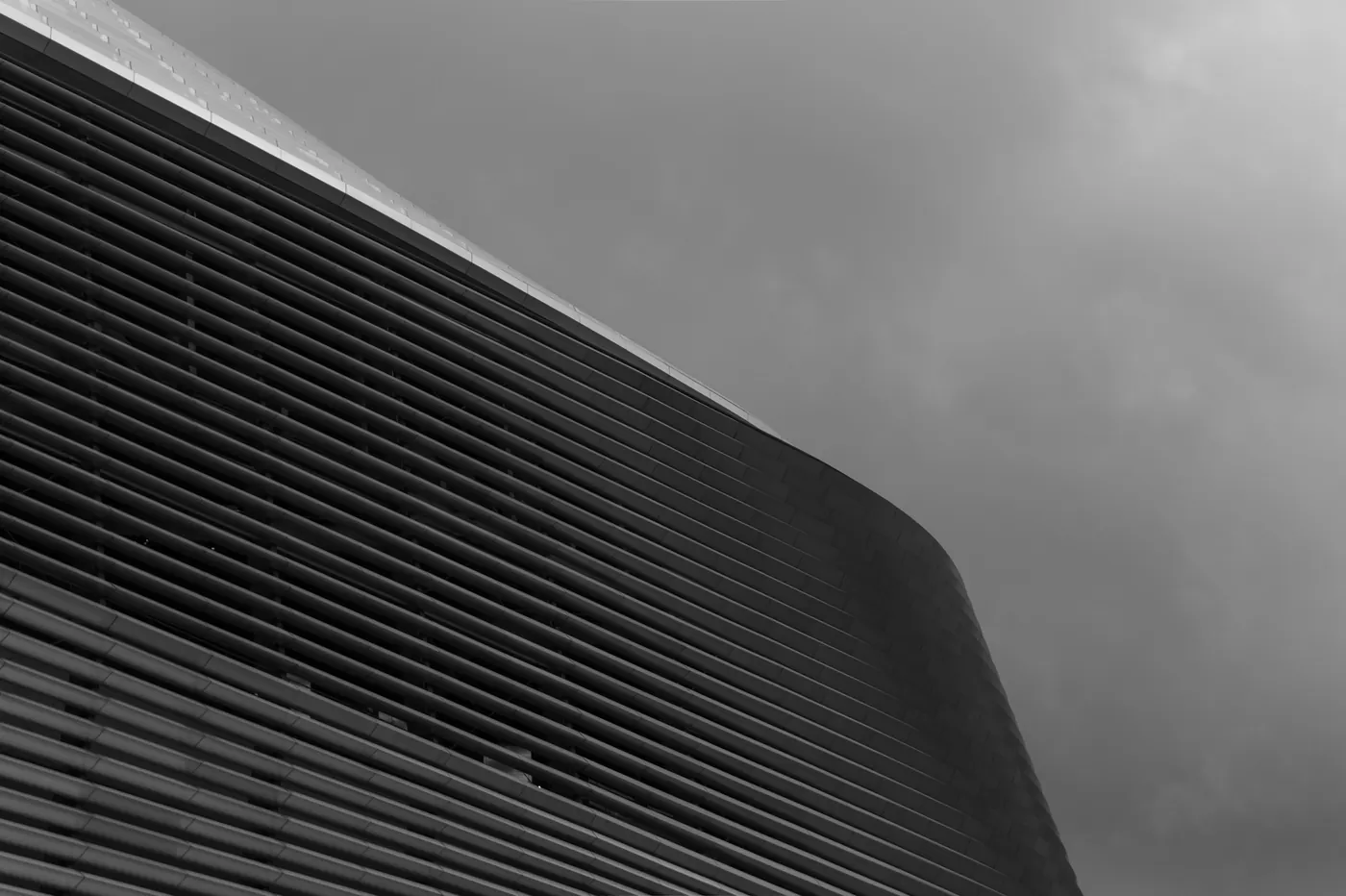
The same blades screen car parks, plant rooms, generators and rooftop equipment. In that role the priority changes: airflow, the stopping of rain and noise, and security take over from sun angle. A louver for plant must be sized for the air it has to move, and the area behind it must drain any rain that gets in. If you need it, say what it is for when you ask for a price.
What a shading study shows
Sun angles can be calculated for any location, date and time, and a shading study uses them to test a design before anything is made. It shows, for each window, when direct sun reaches the glass through the year, and how much of it a given set of blades blocks. The result is not a single number but a picture: the hours of shade at each season, and the times of day when the building is still exposed. Designers use it to choose the blade depth, spacing and angle, and to decide where fixed fins are enough and where an operable system earns its cost.
It also shows what the fins cost in daylight. A scheme that blocks nearly every ray of sun may leave the room dim, and the lights then add heat of their own. The aim is a balance, and the study is how you find it, on paper, before you commit to hardware.
Wind, noise and fixings
Fins are a large area of thin aluminium standing in the wind, so they are designed for the same wind loads as the facade, with supports at the spacing that keeps them from bowing or vibrating. A blade that flutters hums in the wind, and the sound travels into the building. Longer blades need intermediate supports and a stiffer section. The brackets and the structure behind them carry the load back to the building, and they must be designed with the same care as the blades, since they are often the more expensive and more visible part of the system.
Where the fins are in front of glass that is cleaned from a maintenance cradle, the supports must leave a clear path for it, or the fins must be designed to be reached from the side. It is far easier to plan that at the start than to find out on handover day.
What drives the cost
The blade itself is rarely the biggest cost. The supports, the length and number of brackets, the finish, the access needed to install and clean it, and the motors and controls on an operable system all add up, and they scale with the area and the height of the screen. A deep, closely spaced screen costs more than a shallow, widely spaced one, and a screen that follows a curved or stepped facade costs more than one on a flat wall. Ask for the price split by blades, supports and finish, so you can see where a change would save money.
Questions to ask a supplier
- What blade sections and sizes are available, and which have been tested for wind and, where relevant, rain?
- How are the blades fixed, and how is thermal movement allowed for?
- What is the longest unsupported blade length for this wind load?
- How does the finish perform in this climate, and what does the warranty require?
- For operable systems, who supplies the motors and controls, and what happens in a power failure?
Mistakes to avoid
- Using the same fin on every elevation regardless of orientation.
- Choosing a very dense screen that makes the interior dark and needs lights on all day.
- Forgetting the support structure behind the blades, which can cost more than the blades themselves.
- Not planning access for cleaning the glass behind a deep screen.
- Specifying operable blades without a plan for maintaining them.
Fenza produces louver and fin blades in aerofoil, elliptical, rectangular and Z/C-type profiles, from 50 to 400 mm, run horizontally or vertically, fixed or operable, in 6063-T6 extruded aluminium with anodised, powder-coated, PVDF or wood-grain finishes (indicative; confirmed per project). See Louvers & Sun-Shading Fins.
General guidance for orientation, not a specification. Applicable standards, values and details are confirmed per project with the facade consultant.